
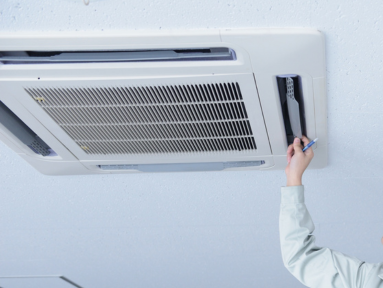
A single mold complaint from a hotel guest is rarely about one room. By the time a guest notices a musty smell near an AC vent or spots discolouration on a ceiling tile, conditions inside the HVAC system have typically been developing for some time. The visible sign is the end of a process, not the beginning of one.
This article explains that process: where mold establishes itself inside hotel air systems, why it spreads before it becomes visible, and what a structured response looks like in practice. It is intended for facilities directors and engineering managers who want to understand the problem at a technical level before deciding how to act.
Where the Problem Actually Begins
Hotel HVAC systems run continuously. Unlike commercial offices that reduce cooling overnight, a hotel property maintains airflow around the clock across occupied and unoccupied rooms simultaneously. Evaporator coils, condensate drain trays, and the internal surfaces of fan coil unit casings are in sustained contact with moisture for the entire operational year.
When those components are not inspected and cleaned on a defined schedule, organic material accumulates alongside moisture. According to data from the UAE National Centre of Meteorology (NCMS), outdoor relative humidity along the UAE coast reaches or exceeds 80 percent during summer months. In a fully occupied hotel, guests add to that load continuously through respiration, showers, and wet linen; that moisture moves through the room and returns to the fan coil unit via the return air path.
The combination of sustained moisture, organic material, and limited inspection creates the conditions described in research published in Building and Environment (Mendell et al., 2011), which documented a consistent relationship between HVAC maintenance intervals and elevated fungal contamination levels in commercial buildings. In a hotel context, the risk does not sit in one unit; it builds across a property between service cycles.
Why It Spreads Across Rooms
Shared HVAC infrastructure is the mechanism by which a localised issue becomes a multi-room problem. In most hotel properties, supply and return air paths connect multiple guest rooms through a common duct network. Mold spores and microbial volatile organic compounds (MVOCs) introduced into that network circulate continuously.
A guest who detects a musty odour from a supply grille is detecting MVOCs being distributed through the air handling system. This is not a surface smell that housekeeping can address; it is an airborne indicator that an established colony exists somewhere within the ductwork or fan coil system. By the time one guest reports it, the conditions producing it have typically been present across several connected rooms for an extended period.
This is why mold complaints in hotels tend to cluster by zone or floor rather than appearing as isolated incidents. The pattern reflects the shared infrastructure, not random contamination events.
Conditions That Warrant a Professional Assessment
The following indicators, individually or in combination, suggest that a professional assessment is the appropriate next step rather than additional maintenance work.
- Musty odour complaints from more than one room, or from the same room repeatedly across different guest stays
- Condensation visible around fan coil units, supply grilles, or ceiling panels in occupied rooms
- Humidity readings consistently above 60 percent in occupied areas, particularly during peak occupancy
- Any water ingress incident, whether from roof, pipework, or facade, that was not followed by a documented drying and inspection process
- Guest complaints concentrated within a specific floor, wing, or zone of the property
- Visible discolouration around AC vents, skirting, or window frames in multiple rooms
These are not necessarily signs of a severe problem, but they are signs that the issue lies within the HVAC system rather than on accessible surfaces and requires specialist inspection to scope correctly.
What a Structured Response Involves
Surface cleaning or filter replacement will not resolve a mold issue that has established itself within the HVAC system. The sequence that produces a reliable outcome follows three steps, and the order matters.
The first step is professional IAQ testing. Testing before remediation establishes the scope of contamination, identifies the species present, and creates the baseline against which post-remediation clearance will be measured. Acting without this data risks either under-specifying the work, leaving hidden contamination in place, or over-specifying it and disrupting operations unnecessarily. Envida conducts IAQ testing through a DAC-accredited laboratory, producing documentation suitable for regulatory review and insurance purposes.
The second step is remediation to a recognised standard. Envida follows IICRC S520 guidance, the internationally recognised protocol for mold remediation in commercial environments. This includes establishing negative air pressure containment around the affected area, HEPA filtration of the work zone, safe removal of contaminated materials, and post-remediation clearance testing to confirm the outcome. All work is documented.
The third step is establishing a preventive maintenance structure. AC duct cleaning to NADCA ACR principles, combined with continuous IAQ monitoring, removes the conditions that allowed the problem to develop and provides early detection if conditions begin to deteriorate again. For a hotel property, this replaces reactive complaint management with a programme that surfaces issues before guests encounter them.
The Reputational Calculus
A guest who leaves a review citing mold or air quality does not describe it as an HVAC maintenance issue. They describe it as a cleanliness or comfort failure, and those framing travels. Review platforms aggregate those signals in ways that affect booking decisions independently of how the property responds.
The operational case for a structured IAQ programme is not primarily compliance; it is about removing a category of complaint that cannot be managed through housekeeping alone. Once the HVAC system is clean and monitored to standard, the conditions that produce those complaints are no longer present.
Envida is a NADCA and IICRC-certified indoor air quality and mold remediation company with extensive experience across hotel properties in Dubai and the UAE.
Need support with indoor air quality, mold assessment, HVAC hygiene, or continuous monitoring?
📞 +971 4 361 7949
Available 24/7 across Dubai and the UAE
Frequently Asked Questions
Can mold in one fan coil unit affect rooms on different floors?
Yes, if the return air paths are connected. In centrally ducted systems, mold spores and MVOCs can travel through shared infrastructure and affect rooms that are not physically adjacent to the source unit.
How quickly can mold develop in a hotel HVAC system?
Under sustained moisture conditions, mold can begin developing within 24 to 48 hours on organic surfaces inside a fan coil unit or condensate drain tray. Without periodic internal inspection, an established colony can be present for weeks or months before guests detect it.
Is mold remediation disruptive to hotel operations?
Envida’s remediation process is designed for occupied commercial environments. Containment protocols isolate the work area from adjacent rooms and common areas. The level of operational disruption depends on the scope of contamination; a scoped assessment before work begins allows for accurate planning.
What is the difference between HVAC servicing and professional mold remediation?
Standard HVAC servicing addresses mechanical performance: filters, coil condition, refrigerant, and belt wear. It does not typically include internal inspection of ductwork or fan coil casings for biological contamination. Mold remediation under IICRC S520 guidance specifically addresses microbial contamination, its containment, and its removal to a verified standard.
How does continuous IAQ monitoring help hotel operators?
Continuous monitoring tracks humidity, CO2, VOCs, and particulates in real time across zones. A humidity excursion that would otherwise go undetected until the next service visit becomes visible immediately, allowing maintenance teams to respond before conditions develop into a contamination event or a guest complaint.
