
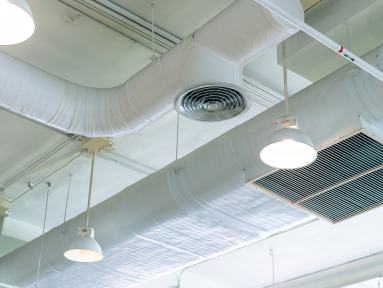
Most commercial duct cleaning in the UAE is sold as NADCA compliant. Rather fewer proposals state which verification method will be used, what threshold defines a clean surface, or who on site holds the certification the standard calls for.
ACR, the NADCA Standard, is a voluntary industry standard rather than a legal requirement. That matters less than it appears, because once a contractor claims to work to it, the claim carries specific and checkable content.
This article is written for facilities managers, engineering teams, and procurement staff evaluating duct cleaning proposals. It sets out what the standard specifies on inspection frequency, cleaning method, cleanliness verification, antimicrobial use, and personnel certification, so you can assess whether a proposal matches the standard it cites.
Assessment comes before cleaning, and the standard is explicit about it
Under NADCA’s framework, inspection determines the need for cleaning and establishes the defined scope of work. Building owners are advised to require that a contractor conducts an assessment prior to performing the work.
The same guidance sets routine inspection intervals by building use. For commercial, industrial, and healthcare buildings, air handling units, supply ducts, and return and exhaust ducts are each listed at annual inspection. These are described as minimum recommendations, with more frequent inspection advised where geographical, human, or mechanical conditions make it necessary. For facility maintenance duct cleaning in the UAE, ambient dust loading and an extended cooling season are precisely the geographical conditions that clause contemplates.
This also means an ac duct inspection is a distinct deliverable from cleaning, not a sales visit preceding it.
Cleaning means mechanical source removal
The standard describes cleaning as the use of an agitation device to dislodge contaminants, followed by capture with a vacuum collection device, and removal of those contaminants from the facility. NADCA’s own project specification requires source removal mechanical methods for this purpose.
It also sets out the controls: HEPA filtered equipment at a minimum collection efficiency of 99.97 percent at 0.3 micron, the system held at negative differential pressure relative to indoor non-work areas throughout, and no unfiltered discharge from vacuum collection devices to outdoors.
Scope covers the system rather than the ducts alone. Supply, return and exhaust ducts, air handling units, heat transfer coils, fans and fan housings, condensate pans and drains are all named, with the specific scope set by the building’s configuration. A hvac duct cleaning scope that excludes coils and condensate pans is not describing the whole system.
Clean is a measured threshold, not a visual opinion
This is the part most proposals leave out, and it is the most useful thing a facilities manager can ask about.
For non-porous surfaces, the specification sets the NADCA Vacuum Test: a surface is considered acceptably clean when the net weight of debris collected on the filter cassette is less than 0.75 mg per 100 cm². For porous surfaces, it sets a Surface Comparison Test, passing a HEPA-filtered contact vacuum over the test area and comparing tested against untested areas. Visual inspection of both surface types is required alongside this.
So cleanliness under the standard is verifiable, with a number attached for non-porous surfaces. A proposal citing NADCA ACR that names no verification method is citing a standard it has not committed to demonstrating.
Antimicrobial treatment is conditional, not routine
The specification is direct on this. Antimicrobial agents are to be applied only where active biological growth is reasonably suspected, or where unacceptable levels of biological contamination have been verified through testing, and then in accordance with the manufacturer’s written recommendations and the associated EPA registration listing.
A fixed annual disinfection line on a maintenance contract is therefore not what the standard describes. Where growth is confirmed, the work belongs under mold remediation rather than within a routine clean.
Certification applies to named roles
The specification requires a NADCA-certified Air Systems Cleaning Specialist responsible for project oversight, and an ASCS or NADCA-certified Ventilation Inspector for site inspections, with the contractor a current NADCA member experienced in work of comparable size and complexity. When assessing an ac duct cleaning company, company-level membership and individual certification are separate questions worth asking separately.
What to require in a proposal
- Proof of NADCA membership and named ASCS certification for the site supervisor
- Assessment before pricing, with the resulting scope documented
- The system components in scope, listed individually
- The verification method and the threshold that will be applied
- Insulation condition assessed, with material identified for replacement where cleaning cannot restore it
- Antimicrobial application only on a stated and evidenced basis
- Pre and post condition documentation
Our guidance on what maintenance contracts typically exclude and the Q4 duct hygiene checklist cover the operational side of the same programme.
Discuss a standards-aligned duct cleaning scope for your facility.
Envida Environmental is a NADCA-certified provider of duct cleaning services in Dubai and across the UAE, delivering commercial HVAC duct cleaning services with documented assessment, verification, and reporting for commercial, hospitality, healthcare, education, and industrial facilities.
📞 +971 4 361 7949
📧 admin@envida.ae
Available 24/7 across Dubai and the UAE
Frequently Asked Questions
How often does NADCA recommend commercial ductwork be inspected?
For commercial, industrial, and healthcare buildings, annually for air handling units and supply, return, and exhaust ducts, as a minimum recommendation rather than a ceiling.
What threshold defines a clean duct surface?
For non-porous surfaces, the NADCA Vacuum Test treats under 0.75 mg of debris per 100 cm² as acceptably clean. Porous surfaces use a comparison test instead.
Is NADCA ACR a legal requirement in the UAE?
No. It is a voluntary industry standard. Its value is that a contractor claiming compliance has committed to specific methods, verification, and certification.
Should antimicrobial treatment be included as standard?
Not under the specification. It applies where growth is suspected or verified by testing, following the product’s registration and manufacturer instructions.
What certification should the site supervisor hold?
NADCA certified Air Systems Cleaning Specialist. Site inspections call for an ASCS or a NADCA-certified Ventilation Inspector, and company membership is a separate question from individual certification.
Does industrial air duct cleaning follow the same standard?
Yes. Industrial buildings sit in the same inspection classification as commercial and healthcare, with scope set by system configuration and process contaminants.
