
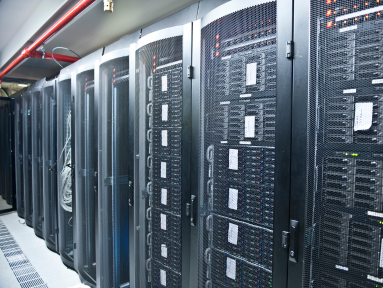
Data centre managers monitor server temperatures, network latency, power consumption, and rack utilisation in real time. The precision cooling infrastructure feeding those racks, including AHUs, supply ductwork, and precision cooling units, is frequently maintained but rarely audited for air quality or particulate contamination. The two activities are not the same thing.
ASHRAE Technical Committee 9.9, which sets environmental guidelines for mission-critical facilities, recommends that data centres maintain a cleanliness level consistent with ISO 14644-1 Class 8. That standard governs airborne particle concentrations across the entire controlled environment, not only the server room floor. When the cooling infrastructure carrying air into that environment contains accumulated contamination, compliance cannot be confirmed through hardware monitoring alone.
Where Contamination Actually Enters the IT Environment
The standard assumption in data centre management is that contamination risk sits on the raised floor: foot traffic, open packaging, and cable dust controlled through access procedures and cleaning schedules. The HVAC pathway receives less scrutiny, partly because it is out of sight and partly because its filtration is assumed to be managed through the unit maintenance contract.
Filters trap particles in the airstream. They do not clean the surfaces upstream, the internal casing of the AHU, or the duct sections between the cooling unit and the raised floor supply plenum. Particulate matter that accumulates in those components is distributed into the IT environment continuously during normal operation, independently of filter condition.
What Particulate Contamination in the Cooling System Means for Hardware
As hardware component sizes have reduced, susceptibility to contamination has increased. ASHRAE TC 9.9’s guidance on particulate contamination in data centres notes that particulate accumulation on circuit boards, cooling fans, and heat sinks impairs heat dissipation, disrupts airflow patterns across server chassis, and in some hardware categories voids OEM warranty conditions. ISO 14644-1 Class 8 defines the maximum allowable airborne particle concentrations for the delivered air. If the supply pathway is contaminated, that threshold may not be met regardless of what the floor-level audit records.
Signs Your Cooling Infrastructure May Need an Air Pathway Audit
In our experience across data centre environments in the UAE, the following indicators commonly precede a finding of contamination in the cooling infrastructure:
- Increased particle counts during routine environmental monitoring that cannot be attributed to raised floor activity.
- Recurring dust accumulation inside IT equipment despite regular server room cleaning.
- Unexplained fan contamination or bearing wear reported by hardware maintenance teams.
- Cooling performance issues that cannot be traced to a mechanical fault in the unit itself.
- No documented air pathway inspection since the facility was commissioned or last refurbished.
None of these individually confirms a contamination problem in the cooling infrastructure, but any one of them is a reasonable basis for commissioning an inspection rather than waiting for a measurable hardware event.
What an Air Pathway Audit Involves
An air pathway audit is distinct from a server room cleaning scope. It covers the full cooling infrastructure: AHU internal surfaces, supply ductwork, raised floor plenum, and filter condition assessment, concluding with airborne particle count testing at supply diffuser level to verify Class 8 compliance in the delivered air. Envida’s data centre cleaning and inspection service covers the complete air pathway, with post-cleaning verification provided as standard. For facilities that require ongoing visibility between audits, Envida’s Sensgreen continuous monitoring platform tracks particulate levels, temperature, and humidity in real time across the controlled environment.
Speak to Envida About a Data Centre Air Pathway Inspection
If your data centre environmental programme does not currently include inspection of the cooling infrastructure air pathway, contact Envida to discuss an assessment scope.
📞 +971 4 361 7949
Available 24/7 across Dubai and the UAE
Frequently Asked Questions
What is ISO 14644-1 Class 8 and why does it apply to data centres?
It defines maximum airborne particle concentrations for controlled environments. ASHRAE TC 9.9 identifies it as the appropriate cleanliness standard for data centre environments.
Does HVAC maintenance cover the air quality risk in the cooling infrastructure?
No. Unit maintenance covers mechanical performance. It does not include inspection or cleaning of internal duct surfaces or AHU casings for particulate contamination.
How does particulate contamination in HVAC affect IT hardware?
It impairs heat dissipation, disrupts airflow across server chassis, and in some hardware, categories can void OEM warranty conditions.
How often should the cooling infrastructure in a data centre be inspected?
In our experience, at least annually, with additional inspections following any modification to the cooling system or significant change in facility load.
What is the difference between a server room cleaning scope and an air pathway audit?
Server room cleaning addresses raised floor and rack-level contamination. An air pathway audit inspects the HVAC infrastructure supplying air into the IT environment.
