
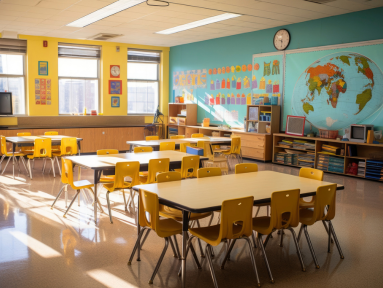
Why School Breaks Create the Perfect Mold Window
The UAE’s climate doesn’t pause the academic calendar. During summer and mid-term breaks, outdoor humidity remains high, and buildings left on minimal AC scheduling retain moisture in ways that active, well-ventilated campuses don’t.
The result: condensation accumulates inside ducts, moisture settles behind wall panels, and any pre-existing dampness accelerates unchecked. Understanding why regular AC duct cleaning is critical for schools and commercial buildings starts with recognising that the risk doesn’t stop when the students leave it often starts.
Mold doesn’t need long. In the right conditions, visible colonies can establish within 24 to 48 hours. Over a two-week break, that’s more than enough time for a classroom to become a health hazard before anyone realises it.
Why Children’s Air Quality Standards Matter
Children’s respiratory systems are still developing, and they breathe at a faster rate than adults, meaning they are exposed to proportionally more airborne contaminants in the same space. A classroom with poor indoor air quality doesn’t announce itself with visible signs. Instead, patterns emerge: clusters of students with persistent coughs, unexplained headaches, or fatigue that is easy to attribute to post-holiday adjustment.
According to WHO guidelines on children’s environmental health, children’s unique vulnerabilities make clean indoor environments not a comfort issue but a protection issue.
The School Break Mold Checklist
The following checklist is built from Envida’s field experience across educational campuses in Dubai, Abu Dhabi, and Sharjah.
Before the Break Begins
- Inspect all AC drain lines and drip trays; blockages cause overflow and create immediate moisture conditions during low activity periods
- Check for existing damp patches or discolouration on ceiling tiles, walls near windows, and bathroom areas
- Set AC systems to maintain humidity control, not temperature alone, a common oversight that allows moisture to accumulate during shutdowns
- Ensure all water leaks or plumbing issues are logged and repaired before the building empties
- Run a baseline IAQ monitoring check to document air quality before the break. This provides a comparison point when school resumes
During the Break
- Schedule a mid-break walkthrough of high-risk areas, including science labs, kitchens, changing rooms, and basement-level classrooms
- Keep ventilation running at appropriate levels; fully switching off airflow encourages stagnation and moisture retention
- Monitor for unusual odours in rooms that were sealed or minimally used
- Check any recently completed construction or refurbishment zones, disturbed areas, and new materials that carry elevated moisture and particulate risk in humid conditions
Before Students Return
- Professional AC duct cleaning service, covering coils, plenums, and ductwork where mold is most likely to establish, and not accessible to routine cleaning
- Full campus IAQ test, air sampling across classrooms, staff rooms, and common areas to confirm air quality before occupation
- Remediate any identified mold immediately does not reopen affected rooms until certified mold remediation is complete.
- Document all actions taken; this forms a compliance record and provides a basis for communication with governing bodies or parents if required
Areas Most Commonly Overlooked
From assessments carried out across UAE educational facilities, the following areas appear clean on inspection but frequently test poorly:
- Science and biology labs: humidity from experiments, sinks, and drainage points
- Changing rooms and sports facilities: moisture from showers and limited ventilation
- Library and archive rooms: paper and organic materials absorb and retain moisture
- Basement and ground floor classrooms, particularly in older campus buildings
In several cases, significant mold growth has been identified in ceiling voids above classrooms that appeared completely normal from floor level. What air testing revealed substantially changed the remediation approach and scope.
Why Visual Inspection Is Not Sufficient
Facilities teams conduct thorough walkthroughs. However, a visual check cannot detect mold inside ductwork, above ceiling tiles, or within wall cavities, the areas where spore concentrations build and where dusty, contaminated AC systems continuously distribute particles across every room they serve.
ASHRAE’s indoor air quality standards for educational facilities are clear: ventilation system maintenance and air quality verification are non-negotiable in spaces occupied by children. A checklist without professional testing behind it does not ensure that the evidence supports.
Schedule a Campus Assessment
Envida works with schools and educational campuses across the UAE to deliver break, scheduled IAQ assessments, AC duct cleaning, and mold remediation, completed before the first day back. Our NADCA-certified, accredited teams have logged over 60,000 safe man-hours and understand the operational requirements of working within educational environments.
Book your campus assessment with Envida before the next break ends.
Available 24/7 across Dubai and the UAE
Frequently Asked Questions
Q: When is the best time to schedule mold remediation for a school?
During term breaks, when classrooms are empty, work can be completed without disrupting students or staff.
Q: How quickly can mold develop in an unoccupied school building?
Under high moisture conditions, mold growth can begin within days in areas such as labs, changing rooms, and poorly ventilated classrooms.
Q: Is a visual inspection enough before students return?
No. Mold inside ductwork, ceiling voids, and wall cavities cannot be detected visually. Professional air sampling is required to confirm that a campus is safe.
Q: How often should schools in the UAE schedule IAQ assessments?
At a minimum, once per year, ideally aligned with the major summer break. Schools with older buildings or previous moisture issues should consider more frequent assessments.
Q: Does Envida provide documentation that schools can share with parents or governing bodies?
Yes. Every assessment and remediation project comes with a full IAQ report suitable for sharing with school leadership, parents, or regulatory stakeholders.
