
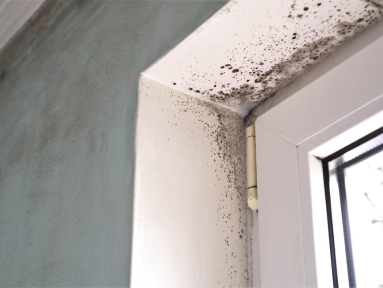
A common assumption in UAE building management is that a running AC system controls indoor humidity and therefore controls mold risk. This assumption is technically incomplete. While acceptable room humidity may be maintained, condensation can still develop inside ductwork and HVAC components, creating conditions that support recurring mold growth.
Understanding how this happens helps facilities managers and building engineers determine whether recurring mold is a surface issue or a symptom of a wider HVAC problem. That distinction is critical because treating visible mold without identifying the underlying moisture source often leads to repeated remediation and unnecessary maintenance costs.
ASHRAE Standard 62.1 Supports ventilation strategies that help reduce conditions associated with biological growth, with 60% relative humidity widely applied as the operational ceiling. However, maintaining an acceptable ambient humidity reading does not prevent condensation from forming on cold surfaces within the HVAC system itself. In UAE buildings, where outdoor relative humidity regularly exceeds 80% during summer months according to the UAE National Centre of Meteorology, the HVAC system is both the primary means of humidity control and a potential source of localised condensation. When these two factors interact poorly, mold can develop within ductwork and fan coil unit casings regardless of the thermostat setting.
How Cold Duct Surfaces Generate Condensation Inside Operating HVAC Systems
When warm, humid outdoor air enters a building; it passes through cooling components: AHU coils, supply ductwork, diffusers, and fan coil unit casings. If any of those surfaces drop below the dew point of the surrounding air, condensation forms. In a commercial building in Dubai during summer months, the outdoor dew point can be high enough that even well-maintained ductwork generates condensation during periods of high fresh air intake. That moisture, in contact with dust and organic material that accumulates on duct surfaces over time, creates conditions that support mold development. The problem is compounded when HVAC systems are oversized, incorrectly balanced, or set to supply air at temperatures lower than the design specification.
A common scenario in UAE commercial buildings: meeting rooms and office wings that remain unoccupied over a weekend while the HVAC operates on a reduced schedule. Moisture can accumulate around fan coil components and duct surfaces during that period without generating visible signs until occupants return.
Why Surface Remediation Does Not Resolve a Systemic Problem
Visible mold on a wall, ceiling tile, or surface is a symptom. If the HVAC system is the moisture source, treating the visible surface without inspecting the ductwork and AHU components will produce a predictable outcome: the mold returns. The IICRC S520 standard for professional mold remediation distinguishes between mold conditions based on the area affected and whether the HVAC system is involved in spore distribution. A Condition 2 finding requires a different scope than a Condition 3, where cross-contamination through the air system has occurred. Most recurring mold cases in commercial UAE buildings are assessed as Condition 2 and treated without the HVAC pathway being considered. For a more detailed overview of how mold classification affects remediation scope, see our guide on mold management strategy for large commercial buildings in the UAE.
What a Structured Assessment Should Include
A professional assessment of a recurring mold problem in a commercial building should go beyond swab sampling of visible growth. In a UAE context, it should include:
- A visual inspection of accessible ductwork, AHU components, and fan coil unit casings for signs of moisture accumulation and biological growth.
- Air and surface sampling to identify mold species and concentrations, following IICRC S520 sampling protocols.
- Humidity and dew point mapping across affected areas, particularly at supply diffusers and return air pathways.
- A review of HVAC operating parameters against design specifications, including supply air temperature, fresh air intake volumes, and drainage line condition.
The purpose is to determine whether the mold source is architectural, involving wall cavities or building envelope failures, or systemic, involving the HVAC distribution network. The remediation scope should address the confirmed source. For a full overview of what Envida’s mold assessment and remediation process involves, including sampling methods and post-remediation verification, visit our service page.
Preventing Recurrence: Monitoring Humidity at the Source
Once the source has been addressed, ongoing humidity monitoring is the most reliable method to detect risk conditions before they produce another visible event. Envida’s Sensgreen continuous indoor air quality monitoring can be deployed across commercial buildings to track humidity, temperature, CO₂, and particulate levels in real time, providing the operational data that a point-in-time IAQ test cannot. If your building has experienced two or more mold events in the same location after treatment, the HVAC system should be part of the next assessment before any further surface remediation is commissioned. See also: how HVAC-related mold affects hotel operations.
Speak to Envida About a Mold Assessment
If you are dealing with recurring mold in a commercial building and need an assessment that includes your HVAC system, contact Envida.
📞 +971 4 361 7949
📧 admin@envida.ae
Available 24/7 across Dubai and the UAE
Frequently Asked Questions
Can mold grow inside commercial AC ductwork in Dubai?
Yes. The ambient temperature and humidity that occupants experience in a room does not reflect conditions on the internal surfaces of ductwork. Cold duct walls, poorly insulated sections, and condensate drain trays can hold moisture and support mold growth even when the occupied space meets acceptable comfort levels.
How do I know whether mold in my building is a surface issue or an HVAC issue?
The clearest indicator is recurrence. If mold returns to the same location after professional treatment, the source has not been identified or addressed. An HVAC inspection, including sampling at supply registers and within AHU components, should be part of any follow-up assessment.
What does IICRC S520 Condition 3 mean for a commercial building?
A Condition 3 finding under the IICRC S520 standard means mold is present beyond the initial contamination zone, typically as a result of HVAC distribution. It requires a broader remediation scope, including containment, HEPA filtration, and decontamination of HVAC components. It is not addressed by surface cleaning alone.
How often should HVAC components be inspected for mold risk in UAE buildings?
In our experience across UAE facilities, condensate drain trays and AHU casings should be inspected at least twice a year, with additional checks following any period of reduced occupancy or HVAC system modification. Buildings that have had previous mold events should maintain a more frequent inspection schedule as part of their remediation verification programme.
What indoor humidity level should a commercial building in Dubai maintain?
Most building engineers apply a ceiling of 60% relative humidity for occupied commercial spaces, consistent with ASHRAE guidance on ventilation and moisture control. In UAE conditions, maintaining that level reliably requires both a functional HVAC system and active monitoring; particularly during the coastal humidity season between June and September. For sector-specific requirements such as healthcare, see our article on IAQ testing and monitoring strategies for Dubai hospitals.
