
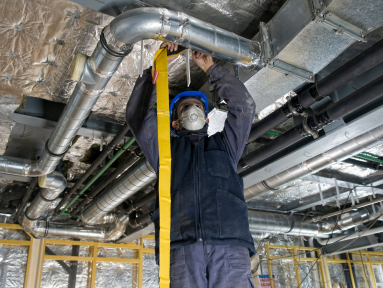
By the end of August, a commercial HVAC system in the UAE has run at or near full load for roughly six months. In that period, it has moved a large volume of air across coils, through filters, and along ductwork, while operating in an external environment with high ambient dust and sustained humidity. The system is still delivering cooling, which is why the condition of the ductwork rarely gets examined.
This article is written for facilities managers, engineering managers, and FM providers deciding whether to schedule duct work before the next budget cycle. It covers what physically changes inside a system over a full cooling season, why the post-summer window is the useful point to inspect, and what a properly scoped inspection should record. The purpose is to help you specify inspection separately from cleaning, rather than committing by default.
What a full cooling season does inside the system
Three changes accumulate, and none of them are visible from the occupied space.
Particulate loading on coils and duct surfaces. Fine dust bypasses filters, particularly where filter seating is imperfect, or media has been left in place beyond its rated life. Research from Lawrence Berkeley National Laboratory found that typical evaporator coils foul sufficiently to double air-side pressure drop within 7 to 11 years, well inside expected coil service life. In a high-dust climate running for an extended cooling season, that trajectory compresses.
Reduced airflow and increased energy draw. As pressure drop rises, delivered airflow falls. A multi-climate field evaluation of HVAC cleaning measured changes in supply of airflow and energy consumption before and after system cleaning across several sites. The operational signature is familiar: zones that no longer hold setpoint, longer run times, and complaints that get attributed to controls or to the chiller rather than to the distribution system.
Moisture and biological deposition. Condensate drain trays run continuously throughout the season. Where falls are shallow or drain lines partially restricted, standing water persists. Combined with organic material settled on an internal duct liner, this produces the conditions that support microbial growth downstream of the coil. This is the mechanism behind most recurring contamination cases, covered in more detail in our guidance on why mold returns after summer.
Why post-summer is the right inspection window
Inspection at the end of the cooling season measures the system at its worst point, which is the only useful measurement for planning. An inspection carried out in February records a system that has been lightly loaded for months and tells you little about how it performs under duress.
NADCA’s ACR Standard sets out an assess, clean, restore sequence in which routine visual inspection for cleanliness precedes any cleaning decision, with recommended inspection intervals by building use classification. The standard also notes that more frequent inspection is appropriate where geographical or mechanical conditions warrant it, which is directly applicable to UAE facility maintenance duct cleaning programmes.
Framed by this way, an end-of-season inspection is a risk and budget instrument. It tells you whether a commercial duct cleaning scope is required for this cycle, which zones take priority, and what can defensibly be deferred.
What the inspection should record
A credible AC duct cleaning service proposal should be preceded by documented findings covering:
- Internal duct surface condition, captured photographically at defined access points
- Coil face condition and measured pressure differential across the coil
- Condensate drain tray, pan, and drain line fall condition
- Filter condition, seating, and evidence of bypass
- Supply grille condition at zone level, which is the usual trigger for AC vent cleaning in Dubai properties where occupants report visible soiling
- Presence of porous or damaged internal duct liner
- Any visible microbial growth, with sampling were indicated
- A zone-by-zone priority ranking rather than a single site-wide recommendation
If growth is identified, the correct next step is assessment under IICRC S520 rather than cleaning, and our mold remediation service handles that separately. Where results are ambiguous, IAQ testing and verification provides a measured baseline. Where the system is confirmed to be clean, no cleaning should be specified at all.
That last point matters. A duct cleaning service in Dubai that recommends cleaning on every visit is not applying a standard. Envida does not recommend cleaning where inspection shows the system does not require it, and our commercial HVAC cleaning services are scoped from findings rather than from a fixed annual assumption.
Book an end-of-season HVAC inspection for your property.
Envida Environmental is a NADCA and IICRC-certified indoor air quality and HVAC hygiene company delivering duct cleaning services in Dubai and across the UAE for commercial, hospitality, healthcare, education, and industrial facilities.
📞 +971 4 361 7949
📧 admin@envida.ae
Available 24/7 across Dubai and the UAE
Frequently Asked Questions
How often should commercial ductwork be inspected in the UAE?
NADCA’s ACR Standard sets intervals by building use. Given regional dust and an extended cooling season, annual inspection suits most commercial properties, with shorter cycles for healthcare and food service.
Is inspection the same as cleaning?
No. Inspection establishes condition and evidences the scoping decision. Cleaning is the remedial action when findings justify it. The two are separate stages and should be quoted separately.
Does dirty ductwork actually affect energy costs?
Particulate on coils and duct surfaces raises pressure drop, reducing airflow and increasing run time. Published research documents for this. Scale varies by system and should be measured, not assumed.
What is AC duct disinfection and when is it appropriate?
An approved antimicrobial treatment applied after mechanical source removal, where contamination has been confirmed and cleaned. It is not a substitute for source removal.
Can an inspection be done without disrupting operations?
Usually, yes. Access panel checks, coil differential readings, and camera surveys are sequenced around occupancy zone by zone. Shutdown is generally needed only for cleaning work.
What if the inspection shows the system does not need cleaning?
Then it should not be cleaned. The report still establishes a documented baseline, supports compliance records, and identifies when cleaning will become necessary.
