
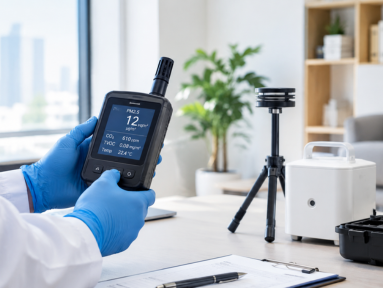
Most UAE commercial buildings manage air quality through periodic indoor air quality testing. A technician attends, records conditions across defined zones, and issues a report. For parameters such as particulate concentration or VOC levels, that method works. For humidity, and therefore for mold risk, it has a structural limitation that no amount of careful scheduling corrects.
This article is written for facilities managers and engineering teams who hold responsibility for both IAQ compliance and mold prevention. It explains why moisture risk behaves differently from other air quality parameters, what a periodic assessment can and cannot evidence, and how the two methods fit together. The intent is to help you decide which parameters warrant continuous measurement in your building, not to argue that testing should be replaced.
What a periodic assessment establishes
An IAQ testing and verification exercise records CO2, temperature, relative humidity, particulate matter, and selected VOCs at the time of measurement, compared against reference thresholds. It produces a compliance benchmark, identifies pollutant sources, and gives a defensible record for Dubai Municipality and DHA purposes.
For most parameters that is sufficient, because the relationship between the reading and the risk is direct. A particulate count of a given value represents a given exposure. Humidity does not work that way.
Mold risk is a duration variable, not a level
Building science models for mold growth treat time as an independent variable alongside temperature and humidity. The critical humidity threshold in these models is defined as the lowest relative humidity that permits growth on a substrate after a given exposure period, and growth indices are calculated in hourly time steps rather than as single values. Germination follows a time lag rather than occurring on contact.
The isopleth systems underlying this work are derived under steady state conditions, meaning sustained temperature and humidity rather than momentary values. The US EPA’s guidance that wet materials be dried within 24 to 48 hours expresses the same principle operationally: the control variable is how long the moisture persists.
A single reading cannot evidence duration. A zone recorded at 58 percent RH may have sat above 70 percent for eleven hours the previous night or may have been stable all week. The number is identical; the risk is not. This is the limitation that scheduling cannot solve, because the missing information is not a peak value but an exposure history.
Why humid climates make this decisive
In a dry climate, an internal humidity excursion decays quickly once the source stops, because the outside air acts as a moisture sink. Ventilation resolves the problem.
In a coastal UAE building, outdoor air is a moisture source for much of the year. An excursion that would self-correct in a temperate climate persists, and ventilation can extend it rather than end it. The same peak humidity therefore produces a far longer period above the growth threshold, which is the quantity that actually matters. Our guidance on why mold returns after summer covers the mechanical side of how those conditions establish.
Where each method belongs
Periodic indoor air quality assessments in Dubai remain the correct instrument for compliance benchmarking, source identification, and post-remediation verification. Continuous measurement is the correct instrument for humidity, because the risk is defined by persistence.
In practice most buildings need a narrow continuous deployment rather than a comprehensive one: sensors in the zones with known moisture history, poor air movement, or previous remediation, supported by scheduled testing elsewhere. Envida’s IAQ monitoring and reporting service uses Sensgreen sensors to log humidity, temperature, CO2, VOCs, and particulates continuously at zone level.
When comparing indoor air quality testing companies in Dubai, the question worth asking is whether the proposal distinguishes between these two functions. A provider quoting IAQ testing services in Dubai for a humidity complaint, without addressing how duration will be established, is offering the wrong instrument for the problem.
For the related question of why occupants complain after a passing test, see our article on annual IAQ tests and continuing complaints.
Discuss an IAQ testing and monitoring strategy for your building.
Envida Environmental is a NADCA and IICRC-certified indoor air quality company providing indoor air quality testing, continuous monitoring, and mold assessment to commercial, hospitality, healthcare, and education facilities across Dubai and the UAE.
📞 +971 4 361 7949
📧 admin@envida.ae
Available 24/7 across Dubai and the UAE
Frequently Asked Questions
Does continuous monitoring replace periodic IAQ testing?
No. Testing provides the compliance benchmark and laboratory-grade source identification. Monitoring provides exposure history. Most buildings need both, applied to different parameters.
Why is humidity treated differently from other IAQ parameters?
Because mold risk depends on how long humidity stays elevated, not the value at any moment. Duration cannot be established from a single reading.
How many sensors does a commercial building need?
Usually fewer than expected. Zones with moisture history, poor air movement, or previous remediation take priority. A site assessment determines placement before deployment.
Can monitoring data support compliance reporting?
It supports it but does not substitute for it. Dubai Municipality and DHA frameworks reference tested parameters, so accredited testing remains the compliance instrument.
What humidity range should a UAE commercial building hold?
WHO and EPA guidance point to keeping indoor relative humidity below 60 percent. The operational question is how often and how long your building exceeds it.
Is short-term monitoring useful, or must it be permanent?
Short deployments of a few weeks are often enough to characterise a specific zone. Permanent monitoring suits buildings with recurring issues or continuous compliance obligations.
