
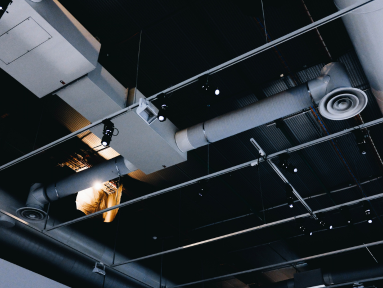
A commercial building can hold an active mold reservoir inside its air handling equipment while producing a clean inspection record, a passing air quality report, and a complete maintenance log. The contamination is not missed through negligence. It is missed because the standard detection regime is not pointed at the place where the growth is.
This article is written for facilities managers, engineering teams, and FM providers investigating complaints that have not resolved. It sets out the specific reasons HVAC contamination evades routine detection, why a normal air sampling result does not exclude it, and what a source-directed inspection covers instead. The purpose is to help you interpret a negative finding correctly, which is a different task from commissioning a test.
The system is a concealed location by definition
The US EPA’s guidance on mold in commercial buildings identifies the HVAC system as one of the locations where extensive hidden mold should be expected, alongside cavities behind wall finishes. The same guidance documents contaminated fibrous insulation inside air handler casings and growth on duct interiors as recognised presentations.
Visual inspection of occupied space cannot reach any of it. What is observable through an access panel is a small fraction of the internal surface area, and porous liner, coil blocks, and drain pans sit outside normal sightlines. A HVAC mold inspection that does not involve internal access is surveying the wrong volume.
The symptom presents away from the source
Contamination inside plant is distributed by supply air. Occupants report odour or symptoms in the zones served, which are frequently not the zones where the growth is. Investigation follows the complaint, so it concentrates on rooms while the reservoir sits upstream in equipment serving several of them.
This produces a recognisable pattern: multiple zones reporting intermittently, no single room worse than the others, and no visible growth found in any of them. That pattern is diagnostic information, but only if the possibility of a shared upstream source is being considered. Our guidance on why mold returns after summer covers the mechanical conditions that allow those reservoirs to establish.
Why a normal air sampling result does not exclude contamination
This is the failure mode that causes most misdiagnosis. Room-level microbial air testing in Dubai measures what is airborne in the occupied space at the time of sampling. Whether a duct-borne reservoir is represented in that sample depends on conditions the sampling report often does not record.
If the system is cycling, a sample taken between cycles captures air that is not communicating with the contaminated surfaces. If the growth is on a surface rather than actively sporulating, release into the air stream may be intermittent. And EPA guidance advises against running a system suspected of contamination, which creates a genuine tension: the system should not be run to disperse spores, yet a room sample taken while it is off carries little information about its interior.
The resolution is to sample the system rather than the space. Surface and swab sampling at coil faces, drain pans, plenum liner, and duct interiors establishes what is present on the surfaces themselves, independent of whether it happened to be airborne during the visit. Air sampling remains valuable for exposure assessment and clearance, interpreted against an outdoor control as set out in our guide to commercial mold risk assessment.
Maintenance records describe activity, not condition
Filter replacement and coil cleaning are logged as completed tasks. Neither entry records the internal condition of the ductwork downstream, and a complete log is routinely read as evidence that the system is clean. It evidences that work was scheduled and carried out. Establishing condition requires inspection, which our guidance on end-of-summer duct inspection sets out separately from cleaning.
Where contamination is confirmed, remediation follows IICRC S520 under containment, with the moisture mechanism corrected before the system returns to service.
Discuss a source-directed HVAC inspection for your building.
Envida Environmental is a NADCA and IICRC-certified indoor air quality company providing mold detection and removal, HVAC air quality testing, and microbial sampling to commercial, hospitality, healthcare, and education facilities across Dubai and the UAE.
📞 +971 4 361 7949
📧 admin@envida.ae
Available 24/7 across Dubai and the UAE
Frequently Asked Questions
Can mold be present if our air quality test came back clear?
Yes. A room sample records what was airborne at that moment. A surface reservoir inside ductwork may not be releasing spores continuously into the sampled air.
Why does a mold inspection service need internal HVAC access?
Because the growth sites are inside the equipment. Coil blocks, drain pans, and porous liner are not visible from occupied space or through a supply grille.
What does HVAC air quality testing involve beyond room sampling?
Surface and swab sampling at coil faces, drain pans, and duct interiors, combined with internal visual inspection and moisture readings, rather than air sampling alone.
Should the AC be running during a mold investigation?
EPA guidance advises against running a system suspected of contamination, as it disperses spores. Sampling should therefore target system surfaces rather than relying on occupied air.
Our complaints move between floors. Does that indicate HVAC contamination?
It is consistent with a shared upstream source. Multiple zones reporting intermittently with no visible growth in any of them warrants inspection of the plant serving them.
Does duct cleaning resolve confirmed HVAC mold?
Not on its own. Cleaning removes deposits. Where growth is confirmed, remediation under containment is required, and the moisture source must be corrected to prevent recurrence.
