
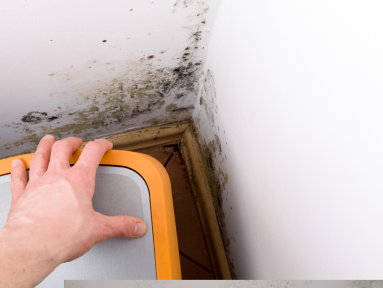
Most mold investigations in commercial buildings begin at the wrong point. Someone reports visible growth or an odour, a contractor attends, and a remediation quote is issued against the affected area. The scope is set by what was visible on the day, and the moisture mechanism that produced it is never established.
This article is written for building owners, facilities managers, FM providers, and estates teams who need to specify or evaluate a mold investigation. It sets out the stages a defensible assessment covers, where microbial sampling fits and where it does not, and what a usable report contains. It is intended to help you judge the quality of an assessment you have commissioned or been offered, not to replace one.
Visible growth is a finding, not a scope
ANSI/IICRC S520, the recognised procedural standard for professional mold remediation, is explicit that determining and correcting the underlying cause of contamination sits with the property owner rather than the remediator. That distinction has practical consequences. A remediation contractor is not obliged to identify why the moisture was there, and a commercial mold inspection scoped only around visible growth transfers no useful information to the building’s owner about recurrence risk.
The EPA’s guidance for mold remediation in schools and commercial buildings similarly sets remediation approach by the extent and material type affected, which requires the extent to be established first. Assessment precedes scope. Where that order is inverted, the building owner is buying an outcome that was defined by a supplier with an interest in its size.
The five stages of a defensible investigation
Building and operational history. Construction type, envelope detail, previous water events, occupancy changes, HVAC modifications, and any prior remediation work. Recurrence in a previously treated area is a different investigation from a first occurrence.
Hygrothermal survey. Relative humidity and temperature logged over time across affected and unaffected zones, not a single spot of reading. The WHO guidelines on dampness and mould identify persistent dampness as the controlling variable, and persistence cannot be evidenced by one measurement.
Physical inspection. Moisture meter readings on substrates, thermal imaging where cavity moisture is suspected, and inspection of the mechanical contributors: condensate trays, drain falls, duct interiors, and insulation conditions. Our guidance on why mold returns after summer covers the HVAC pathways in more detail.
Microbial air testing. Sampling establishes whether airborne spore concentrations indoors are elevated relative to an outdoor control taken the same day. Without that outdoor baseline, an indoor result means very little; ambient fungal load varies by season and location. Microbial air testing in Dubai should also account for the fact that most commercial buildings run in high recirculation, which concentrates whatever is already inside. Surface and bulk sampling supplement air sampling where a specific source needs confirming.
Classification and scope definition. Findings are resolved into a condition category that determines containment requirements, personnel qualifications, and the post-remediation verification standard. Our guide to mold classification in commercial buildings sets out those categories.
Sampling is not the investigation
A frequent misunderstanding is that commercial indoor air quality testing in Dubai constitutes the assessment. It does not. Sampling produces a snapshot of airborne concentration at one moment. It cannot locate a concealed source, identify a drainage fault, or explain a recurrence pattern. Its value is in confirming or excluding a hypothesis that physical inspection has already generated, and in providing a defensible clearance benchmark afterwards.
This is why a mold inspection service that offers sampling alone, with no building survey, produces reports that facilities teams cannot act on. The same principle applies to routine building air quality testing in Dubai: the numbers are useful in proportion to the investigation surrounding them.
What the report must contain
A report suitable for budgeting, tendering, or compliance purposes should state the identified moisture mechanism, the extent and condition classification, the sampling methodology and outdoor control results, a defined remediation scope with containment requirements, the corrective works needed to prevent recurrence, and the verification criteria that will be used to confirm completion.
If a report does not identify a moisture mechanism, the investigation is incomplete regardless of how much sampling it contains.
Commission an independent mold risk assessment for your property.
Envida Environmental is a NADCA and IICRC-certified indoor air quality company providing mold inspection and remediation, microbial air testing, and indoor air quality assessments in Dubai for commercial, hospitality, healthcare, education, and industrial facilities across the UAE.
📞 +971 4 361 7949
📧 admin@envida.ae
Available 24/7 across Dubai and the UAE
Frequently Asked Questions
What is the difference between a mold inspection and a mold risk assessment?
An inspection confirms presence and extent. A risk assessment also establishes the moisture mechanism, classifies condition, and defines scope and verification criteria. Without that, recurrence risk stays with the owner.
When is microbial air testing appropriate?
Where occupants report symptoms without visible growth, where HVAC contamination is suspected, before intrusive work, and post-remediation verification. It is weak as a standalone first step.
Why does an outdoor control sample matter?
Fungal spores exist in outdoor air everywhere, at concentrations varying by season and location. Indoor results are assessed against a same-day outdoor sample. Without it, conclusions are not defensible.
Should the same company assess and remediate?
There is a reasonable argument for separation on larger scopes. Where one company does both, methodology, sampling results, and classification basis should be fully documented for independent review.
How long does a commercial assessment take?
A single zone is typically completed within a day, with lab results following. Whole-building assessments involving humidity logging take longer. Logging periods, not site time, are the usual constraints.
Does an assessment require the building to be vacated?
No. Survey work, sampling, and logging are carried out around normal occupancy. Any occupancy restrictions relate to remediation, not assessment.
