
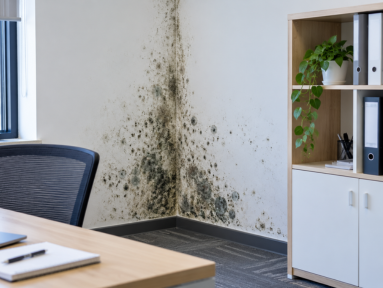
A building can hold indoor relative humidity within the recommended range, pass its air quality assessment, and still accumulate moisture inside its wall assemblies continuously through the cooling season. When mold returns after remediation in these buildings, the indoor humidity reading is rarely the reason. The differential across the envelope is.
This article is written for facilities managers, engineering teams, and building owners dealing with mold that reappears in the same locations after treatment. It explains why humidity imbalance is a pressure and vapour problem rather than a room-level measurement, where that imbalance concentrates moisture in UAE construction, and what it means for how remediation should be scoped. It is intended to support better diagnosis, not to replace a site investigation.
Imbalance is a differential, not a level
Moisture moves down gradients. Vapour diffuses from higher vapour pressure toward lower, and air carrying moisture moves from higher air pressure toward lower. Both processes are driven by the difference across a boundary, not by the value on either side of it.
This is why a compliant indoor reading can coexist with an active moisture problem. The measurement describes the room. The mechanism operates across the wall.
In UAE buildings, vapour is driven inward
In temperate climates, vapour pressure is typically higher indoors than out, so moisture moves outward, and construction detailing assumes that direction. Cooling-dominated climates reverse it. Building science guidance on hot and humid climates notes that outdoor-to-indoor vapour pressure differences during cooling periods can exceed the indoor-to-outdoor differences seen during heating in the same climate, producing sustained inward moisture flow by both diffusion and air movement.
Air conditioning is what creates the gradient. Cooling the interior lowers indoor vapour pressure and chills interior surfaces, so moisture is drawn toward the assembly and meets surfaces that are below the dew point of the air reaching them. In our experience across UAE commercial facilities, this is a year-round condition on the coast rather than a seasonal one.
Interior finishes that trap it
The failure this produces most often in UAE offices and hotels involves impermeable interior wall finishes. Vinyl wall covering has very low vapour permeance, which makes it a vapour retarder positioned on the interior face. In a cooling climate that is the wrong side of the assembly, and moisture accumulates at the interface between the covering and the gypsum board behind it, where paper facing provides the substrate.
The growth is concealed until the covering is removed. Surface treatment of the visible face achieves nothing, which is why mold cleaning services in Dubai scoped to the finish alone tend to be repeat visits, and why office mold removal in these buildings recurs on the same walls.
Negative pressurisation multiplies the load
Air transport carries considerably more moisture than diffusion. Where exhaust systems serving kitchens, toilets, car parks, and smoke control exceed the make-up air supplied, the building runs at net negative pressure and draws humid outdoor air through every gap in the envelope.
Research on infiltration in hot and humid climates notes that commercial buildings in humid regions are generally designed to run at positive pressure specifically to limit mold growth from this mechanism. Where commissioning has drifted, or exhaust has been added without matching supply, that protection is lost without any visible change in operation.
What this means for recurrence
Where imbalance is the driver, remediation scoped to the affected surface will not hold. The investigation needs to establish pressure relationships, the vapour permeance of interior finishes, and surface temperatures relative to dew point, alongside the conventional survey set out in our guide to commercial mold risk assessment.
Where the driver is mechanical rather than envelope-related, our guidance on why mold returns after summer covers the HVAC side. Most recurring cases involve both.
Discuss a root cause investigation for recurring mold in your building.
Envida Environmental is a NADCA and IICRC-certified mold remediation company in the UAE, providing mold removal in Dubai, moisture diagnostics, and mold remediation testing for commercial, hospitality, healthcare, and education facilities. Mold removal UAE-wide is delivered under IICRC S520 containment with the moisture mechanism corrected before reinstatement.
📞 +971 4 361 7949
📧 admin@envida.ae
Available 24/7 across Dubai and the UAE
Frequently Asked Questions
Our indoor humidity readings are normal. Can we still have a moisture problem?
Yes. The reading describes the room, not the gradient across the wall. Moisture can accumulate inside an assembly while indoor conditions remain within range.
Why is vinyl wall covering a problem in UAE buildings?
It acts as a vapour retarder on the interior face. In a cooling climate, moisture moving inward accumulates behind it against the gypsum board rather than drying through.
How do we know if our building is negatively pressurised?
Pressure differentials are measured across the envelope and between zones. Doors that pull hard, persistent draughts at entrances, and condensation near openings are common indicators.
Does mold removal in Dubai need to address pressurisation?
Where infiltration is the moisture source, yes. Cleaning without correcting the pressure regime leaves the mechanism intact, and growth typically re-establishes in the same assemblies.
What is mold remediation testing and when is it required?
Sampling to verify that remediation achieved its objective, carried out after works and before reinstatement. It provides the documented clearance basis for the completed scope.
Can continuous monitoring detect envelope moisture problems?
Partly. It records room conditions and identifies humidity excursions, but confirming envelope moisture requires surface temperature readings, thermal imaging, and inspection behind finishes.
