
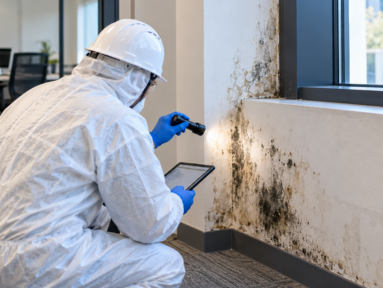
Most recurrence cases are not the result of poor remediation work. The containment was correct, the affected material was removed, and the clearance result was acceptable. The failure sits earlier, in how the work was scoped and who was engaged to do what.
This article is written for building owners, facilities managers, and procurement teams specifying or reviewing a mold remediation scope. It covers how the governing standard divides responsibility between parties, why a compliant clearance result and a predictable recurrence are not contradictory, and what to include in a scope of work so the moisture mechanism is actually assigned to someone. It is intended to support better specification, not to replace professional assessment.
The standard does not make the remediator responsible for the cause
ANSI/IICRC S520 is the recognised procedural standard for professional mold remediation. It is explicit on this point: the standard assumes that determining and correcting the underlying cause of mold contamination is the responsibility of the property owner, landlord, or their agents, and not the remediator, although the owner may contract a remediator or another professional to perform those services.
That is a reasonable allocation. A remediation contractor is engaged to remove contamination to a verified standard and does that competently. But it means the cause is only investigated if somebody is specifically appointed to investigate it. In a typical single-contractor engagement, nobody is, and the omission is contractual rather than technical.
The standard also names a separate role for assessment
S520 carries a dedicated section for the Indoor Environmental Professional, alongside a separate section for post-remediation verification. This is the party who assesses the fungal ecology of the property, sets a sampling strategy, interprets laboratory data, and determines Condition 1, 2, or 3 status. Our guide to mold classification in commercial buildings sets out what those conditions mean in practice.
The role is commonly described as one that should be held by an independent adviser without an ownership affiliation with the remediation contractor. Whether or not a building takes that route, the structural point for procurement holds assessment and remediation are distinct functions in the standard, and buying one does not deliver the other.
A corrected water source is not a diagnosed moisture regime
Post-remediation verification confirms return to Condition 1. Many protocols also record that the water source has been corrected, and for a discrete event, a burst pipe, an overflow, a roof leak, that is a meaningful check with a clear answer.
The difficulty arises where there is no discrete source. Where the driver is a sustained condition rather than an event, there is nothing to tick as corrected: no single failure point, no repair to photograph. Verification can legitimately record a compliant result while the mechanism that produced the growth continues operating unchanged. A certified mold removal scope completed to standard and a recurrence twelve months later are therefore entirely compatible outcomes.
In UAE buildings, the sustained condition is the common case
Cooling-dominated operation produces continuous condensate; surfaces held below the dew point of the air reaching them, and inward vapour movement across the envelope for much of the year. These are regimes, not events. Our guidance on humidity imbalance across the building envelope and on concealed contamination inside HVAC systems covers the two that account for most cases we assess.
This is why commercial mold removal specified from visible growth alone tends to repeat in the same assemblies.
What to put in the scope of work
- Name the party responsible for identifying the moisture mechanism, and make it a deliverable rather than an assumption
- Require a written mechanism finding, not only an extent finding
- State whether assessment and remediation are being bought from the same supplier, and if so, require the assessment methodology and sampling basis to be documented in full for independent review
- Define what verification covers, and separate clearance of contamination from correction of cause
- Specify the corrective works arising from the mechanism finding as their own scope item, with their own budget
- Set out how a recurrence within a defined period is handled, and on what evidence
Where the mechanism is unknown at the point of tender, a commercial mold risk assessment ahead of pricing produces a better-scoped and usually smaller remediation.
Discuss an investigation-led remediation scope for your building.
Envida Environmental is a NADCA and IICRC-certified mold remediation company in the UAE, providing mold assessment, moisture diagnostics, mold remediation testing, and certified mold remediation for commercial, hospitality, healthcare, and education facilities across Dubai.
📞 +971 4 361 7949
📧 admin@envida.ae
Available 24/7 across Dubai and the UAE
Frequently Asked Questions
Whose responsibility is the moisture source under IICRC S520?
The standard assigns determining and correcting the underlying cause to the property owner or their agents, not the remediator, unless the owner contracts someone specifically to do it.
Our remediation passed clearance. Why did the mold return?
Clearance confirms contamination was removed to standard. Where the driver is a sustained condition rather than a discrete leak, it can continue operating after a compliant result.
Should assessment and remediation be bought from different suppliers?
IICRC guidance favours an independent assessor. Where one supplier does both, the methodology, sampling basis, and classification should be documented fully enough for independent review.
What is an Indoor Environmental Professional?
The party S520 anticipates for assessing fungal ecology, setting the sampling strategy, interpreting laboratory results, and determining Condition 1, 2, or 3 status.
What should a remediation quotation include beyond removal?
A written moisture mechanism finding, the corrective works arising from it as a separate priced item, and a defined verification basis distinct from contamination clearance.
Does this apply to small areas of visible growth?
The principle is the same at any scale. A small recurring area in the same location indicates an uncorrected mechanism, regardless of how little surface is affected.
